Logan Butler · 17 October 2026
Voltage Fluctuations and Their Effects on Connector Longevity in Household Beverage Preparation Devices During Variable Daily Demand Cycles
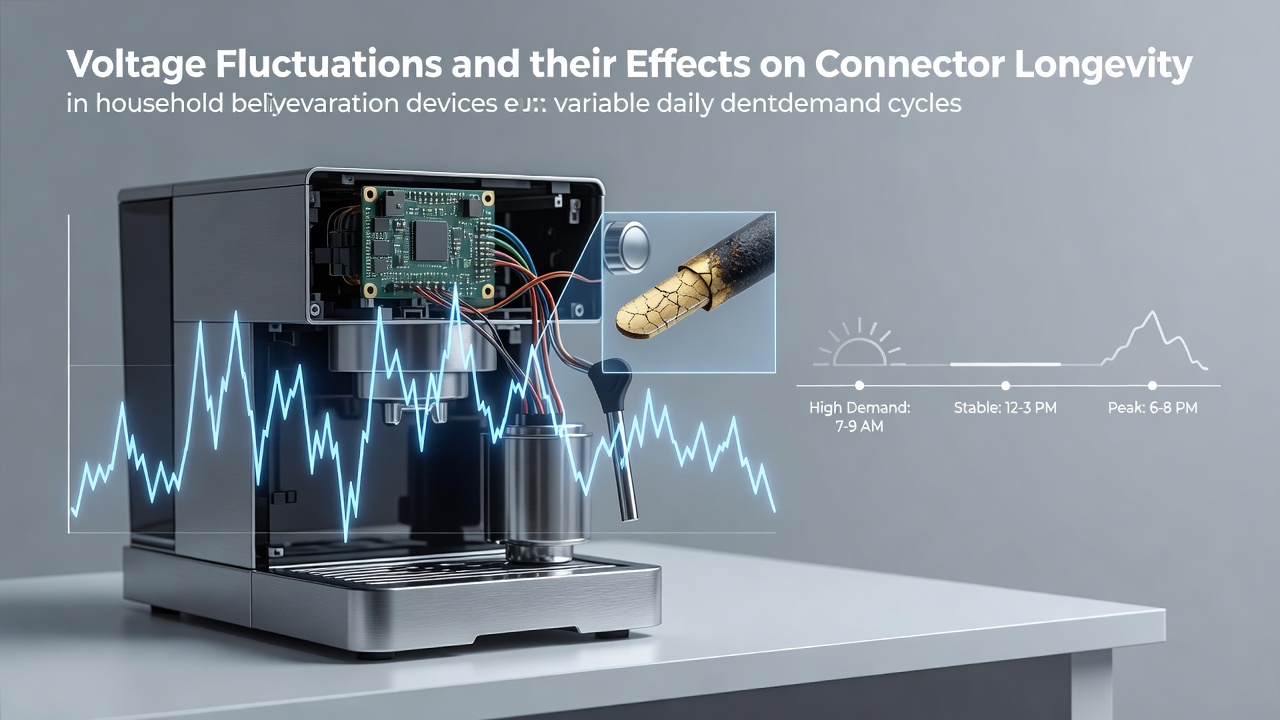
Household beverage preparation devices such as electric kettles and coffee makers experience repeated exposure to voltage fluctuations that occur when grid demand rises and falls throughout the day, and these variations place measurable stress on internal connectors. Data from electrical monitoring programs indicate that morning and evening peaks often produce deviations of 5 to 10 percent from nominal supply levels in residential circuits, while shoulder periods show smaller but still noticeable swings. Researchers tracking appliance performance have documented how these changes accelerate contact wear through localized heating and minor arcing at connection points.
Mechanisms of Voltage Variation in Residential Circuits
Grid operators adjust generation output to match aggregate load, yet rapid increases in simultaneous appliance use create brief imbalances that manifest as voltage sags or swells at the point of connection. Studies conducted by the U.S. Energy Information Administration reveal that residential voltage can drop below 110 volts or rise above 125 volts for intervals lasting several minutes during high-demand windows, and such excursions repeat on a predictable daily rhythm. Beverage preparation equipment draws substantial current during heating cycles, which amplifies the effect when multiple households activate devices within the same 30-minute window.
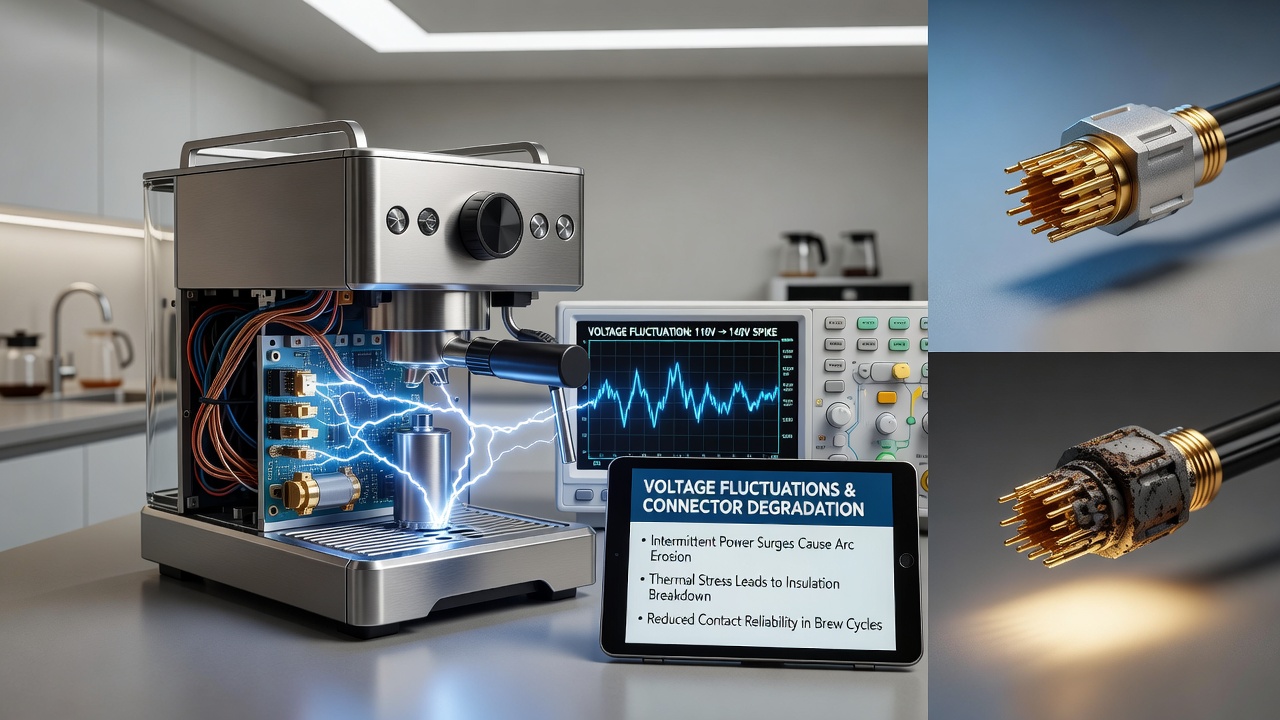
Connectors inside these appliances rely on metal-to-metal interfaces that maintain low resistance under stable conditions, yet fluctuating voltage increases current draw during sags and generates excess heat during swells. Engineers at testing laboratories have measured temperature rises of 15 to 25 degrees Celsius at terminal blocks when supply voltage varies by more than 8 percent, and repeated thermal expansion and contraction loosens mechanical fasteners over time. Oxidation layers form more rapidly under these conditions, raising contact resistance and creating a feedback loop that further elevates local temperatures.
Daily Demand Patterns and Appliance Stress
Usage data collected across multiple metropolitan regions show distinct spikes between 6:30 and 8:30 a.m. as well as 5:00 and 7:30 p.m., periods when voltage stability decreases because distribution transformers operate closer to rated capacity. Observers note that connectors in kettles and single-serve brewers undergo the greatest number of on-off transitions during these windows, and each transition coincides with whatever voltage offset exists at that moment. Laboratory simulations replicating October 2026 load profiles from North American utilities demonstrate that devices subjected to 12 to 15 fluctuation events per day accumulate measurable contact erosion after 400 to 600 operating hours.
Longevity metrics collected by appliance certification bodies indicate that connectors rated for 10,000 cycles under steady 120-volt conditions reach end-of-life thresholds 30 to 40 percent sooner when exposed to the variable supply typical of residential neighborhoods. Australian research groups tracking similar equipment report comparable reductions in service life when daily voltage range exceeds 8 percent, confirming that the phenomenon appears across different grid architectures. The cumulative effect appears in increased resistance readings taken at service intervals, with values climbing from initial 5 milliohms to over 25 milliohms after two years of typical household use.
Material and Design Factors Influencing Connector Durability
Manufacturers select contact materials such as silver-plated brass or tin-coated copper for cost and conductivity balance, yet these coatings degrade when subjected to repeated thermal and electrical stress. Reports from the International Electrotechnical Commission working groups highlight that silver migration and tin whisker growth accelerate under voltage cycling, creating conductive paths that promote arcing and further material loss. Spring tension in quick-connect terminals also relaxes after hundreds of thermal cycles, reducing normal force at the interface and allowing microscopic movement that abrades protective platings.
Design choices including wire gauge, terminal geometry, and potting compounds influence how effectively connectors dissipate the extra heat generated during voltage excursions. Field examinations of returned units show that devices with larger cross-sectional conductors and crimped rather than soldered joints retain lower resistance values after equivalent operating hours. European testing facilities have compiled datasets demonstrating that optimized terminal designs extend functional life by 25 percent even when daily voltage variation remains within documented residential limits.
Measurement Approaches and Predictive Indicators
Technicians employ infrared thermography and four-wire resistance measurements to identify early connector degradation before visible failure occurs. Longitudinal studies initiated in 2024 and continuing into October 2026 have established baseline resistance curves for common connector types, allowing service personnel to flag units approaching critical thresholds. Utilities in several Canadian provinces have begun sharing anonymized voltage telemetry with appliance researchers, enabling more accurate correlation between supply conditions and component wear rates.
Software models that incorporate both load-cycle counts and voltage deviation statistics now predict connector replacement intervals with improved accuracy compared with cycle-count methods alone. These models incorporate data from thousands of monitored households and show consistent patterns across different geographic regions and housing stock ages.
Conclusion
Voltage fluctuations tied to daily demand cycles impose documented stresses on connectors within household beverage preparation devices, and accumulated data confirm measurable impacts on service life. Continued monitoring programs and design refinements offer pathways to mitigate these effects while maintaining the convenience these appliances provide.